
Debt
Debt definitions
Debt can be defined in several ways. When governments are unable to finance their spending out of revenues, they issue bonds and so build up debt. These bonds, and hence the debt, could be denominated in either the local currency or in a foreign currency such as dollars. So government debt (public debt) can be split into external (foreign currency, international) debt and domestic debt. Economists are interested in both total government debt, since an excessive debt stock will become difficult to service and could result in monetisation of future deficits, and in external liabilities, which may become difficult to repay if the local currency falls in value.
However, the private sector also builds up debt by borrowing from banks or issuing bonds. In general, it is the element of this debt that is denominated in a foreign currency which most interests international economists, because taking the government and private sector liabilities together gives a measure of the total indebtedness of the country.
The Economist Intelligence Unit generally forecasts the World Bank definition - debt owed in foreign currency, including foreign currency bonds, suppliers' credits etc. Hence we define debt with reference to the currency. This is not the only possible definition. The Bank for International Settlements (BIS) produces debt figures including foreign currency loans and bonds, and foreign holdings of domestically issued short dated T-bills. And BIS only looks at bank exposure, excluding government and non-financial sector exposure.
The maturity split is also different. World Bank data are based on the contractual maturity when the debt is issued. BIS data are based on the outstanding maturity (ie long-term debt with less than a year to run is classified as short-term).
These differences help to explain why BIS short-term debt figures are much higher than the World Bank figures, and why 1-2 year maturity and 2+ maturity debt combined is much lower than the World Bank private creditors data. Summary figures based on this definition are also included on the database.
A few countries are not covered by the World Bank's debt statistics. In this case we generally use the OECD as a source. The OECD definitions for total debt are closer to the World Bank's, but the presentation is very different. (There are also some definitional differences such as the treatment of suppliers credits.) But the biggest difference is in methodology - the OECD collects data from creditors, while the World Bank uses debtors as the primary data source.
Debt presentation
We mix two distinct presentations on WorldData. The debt stock is split by debtor (although the medium- and long term debt stock is also split by creditor), while flows (debt service) are split by creditor.
Foreign debt stock
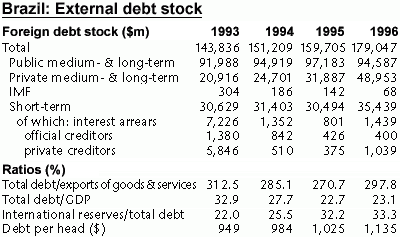
Foreign currency debt split by debtor (ie. who owes what)
|
Medium- and long-term (MLT): maturity of 1 year or more. |
|
Public MLT: Owed by the public sector, or owed by the private sector but guaranteed by the public sector |
|
Private MLT: Owed by the private sector and having no public sector guarantee. |
|
IMF: All monies owed to the IMF, including general resources account and special programmes |
|
Short-term debt: owed by all sectors. Split into principal and capitalised interest arrears (disaggregated: owed to official creditors and owed to private (ie commercial creditors) |
The table below shows how the foreign debt stock is presented in WorldData.
IMF debt
Debt outstanding to the IMF, comprising transactions within the General Resources Account and loans relating to any structural adjustment facility (SAF), enhanced structural adjustment facility (ESAF) or trust fund loan (TFL).
Short-term debt
External (foreign currency) debt owed to all sectors (ie private and public creditors). Short-term debt is any debt with an original maturity of up to one year. Interest arrears which have been capitalised are included.
Medium- and long-term debt stock
Split by creditor (ie who is it owed to)
|
Official bilateral and multilateral |
|
Private creditors (ie owed to commercial lenders), both private non-guaranteed and private but guaranteed by some official body. Made up of foreign currency bond holdings, bank loans and other credits. |
Export credits
Advance payments to exporting companies, which have been guaranteed in some way. Both short and long term.
Debt owed to BIS banks
Owed by all sectors to BIS banks (even if it is owed to a branch office within your country). Note that the 0-1 year maturity series is one possible definition of "short-term debt". Also note that this differs from the short-term debt figure in the Foreign debt stock section as BIS data includes foreign banks purchases of local currency debt (ie holdings of local currency bonds).
Foreign debt service
Split by creditor (ie. who is it owed to).
|
Official bilateral and multilateral |
|
Private creditors (ie owed to commercial lenders), both private non-guaranteed and private but guaranteed by some official body. Made up of foreign currency bond holdings, bank loans and other credits. |
|
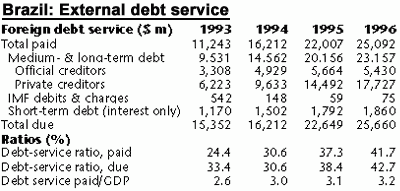
IMF debits and charges = Repurchases and repayment of loans to the IMF, plus charges on loans. |
|
Short term debt interest |
|
Paid and due. Difference is arrears. |
The table below shows the presentation of foreign debt service on WorldData.
Principal repayments
split by creditor (ie who is it owed to)
|
Official bilateral and multilateral |
|
Private creditors (ie owed to commercial lenders), both private non-guaranteed and private but guaranteed by some official body. Made up of repayments of foreign currency bond holdings, bank loans and other credits |
|
IMF debits: Repurchases and repayments of loans including transactions within the General Resources Account and repayment of loans relating to any Structural Adjustment Facility (SAF), Enhanced Structural Adjustment Facility (ESAF) or Trust Fund Loan (TFL). |
|
Paid and due. Difference is arrears |
|
Official bilateral and multilateral |
|
Private creditors (ie owed to commercial lenders), both private non-guaranteed and private but guaranteed by some official body. Made up of interest payments and coupons on foreign currency bond holdings, bank loans and other credits |
|
IMF charges |
|
Interest on short term debt |
|
Paid and due. Difference is arrears. |
Effective interest rate on debt
Interest payments made on medium- and long-term debt in current year as a percentage of medium- and long-term external debt at the end of the previous year. A kind of weighted average of all the different rates payable.
Effective debt maturity in years
Total medium- and long-term debt in the previous year divided by medium- and long-term principal repayments paid for the current year expressed in years. How long it would take to pay off the current debt stock if repayments remained at current levels and no further disbursements were made.
Change in arrears
This is the difference between the interest and principal a country has paid, and what was actually due.
Related topics:
|
Capital account |
|
Trade and the current account |